Physical Address
304 North Cardinal St.
Dorchester Center, MA 02124
Physical Address
304 North Cardinal St.
Dorchester Center, MA 02124
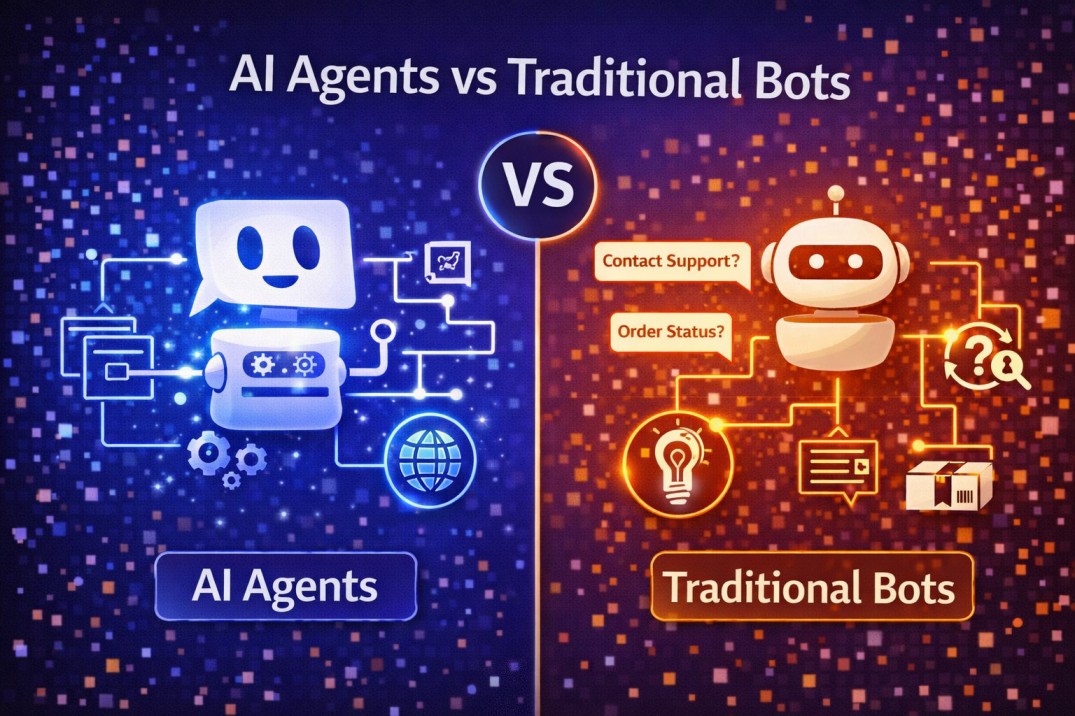
The conversation around automation has evolved rapidly over the past few years. What was once dominated by rule-based chatbots has now shifted toward a new paradigm AI agents. While both technologies aim to automate interactions, the difference between them is not incremental; it is fundamental.
Understanding this shift is critical for any business looking to improve customer engagement, lead generation, and operational efficiency in 2026.
This article provides a deep, technical yet practical explanation of the difference between traditional bots and AI agents, and how Nexus Botix represents a new approach to building intelligent, business-ready AI systems.
Traditional chatbots were designed around a simple idea: if a user says X, respond with Y.
These systems rely on predefined rules, decision trees, and scripted flows. While effective for basic use cases, they struggle with variability. Any deviation from expected input often results in failure or irrelevant responses.
AI agents, by contrast, are built on language understanding, contextual reasoning, and dynamic response generation. Instead of following rigid flows, they interpret intent and generate responses based on knowledge and context.
Research from McKinsey & Company highlights that AI-driven systems are significantly more effective in handling complex, unstructured interactions compared to rule-based automation. This is because they operate on probabilistic reasoning rather than deterministic logic.
Traditional bots are rule-based automation systems that follow predefined scripts.
They typically operate using:
For example, a traditional bot may respond correctly when a user selects options like “Pricing” or “Support,” but struggle when a user asks a question in natural language.
This limitation is well-documented in studies by Gartner, which note that rule-based bots often fail when user input falls outside predefined scenarios.
While traditional bots can still be useful for structured tasks, they lack the flexibility required for modern customer interactions.
AI agents represent a shift from scripted automation to intelligent systems that can understand, reason, and respond dynamically.
They are built using advanced AI models, such as those developed by OpenAI and Anthropic, combined with retrieval systems that ground responses in real data.
An AI agent can:
According to Google, modern AI systems are increasingly capable of handling multi-turn conversations, making them suitable for real-world business applications.
The most important distinction between traditional bots and AI agents lies in how they process information.
Traditional bots operate on logic-based execution. Every possible path must be defined in advance. This creates limitations in scalability and adaptability.
AI agents operate on knowledge-driven intelligence. They do not need predefined paths for every scenario. Instead, they draw from a structured knowledge base to generate responses dynamically.
This shift allows AI agents to handle:
In essence, traditional bots execute instructions, while AI agents make informed decisions.
This is where Nexus Botix introduces a fundamentally different approach.
Rather than treating AI as a tool, Nexus Botix positions AI agents as digital employees.
Instead of building conversation flows manually, businesses can:
The result is an AI system that understands your business and can communicate it effectively to customers.
This approach eliminates the need for complex scripting and allows businesses to deploy intelligent agents much faster.
One of the biggest limitations of traditional bots is their inability to maintain context.
Each interaction is treated as an isolated event, leading to fragmented conversations. This often frustrates users and reduces engagement.
AI agents, on the other hand, are designed for contextual continuity.
They can:
This capability significantly improves customer satisfaction, as users no longer need to repeat themselves or navigate rigid flows.
Traditional bots are typically passive. They respond when prompted but rarely guide users toward meaningful outcomes.
AI agents are inherently goal-oriented.
With platforms like Nexus Botix, businesses can design agents that:
Research from Salesforce shows that conversational AI can significantly improve lead conversion rates when integrated into customer journeys.
This transforms chatbots from support tools into revenue-generating assets.
Scalability is another area where AI agents outperform traditional bots.
Expanding a rule-based bot requires adding more scripts, flows, and conditions. This quickly becomes complex and difficult to maintain.
AI agents scale differently. By expanding the knowledge base, the system automatically becomes more capable.
With Nexus Botix, businesses can scale their AI by simply adding more data, refining responses, and integrating additional channels such as WhatsApp and Facebook Messenger.
This reduces operational overhead while increasing capability.
Perhaps the most important advantage of AI agents is their ability to improve over time.
Traditional bots require manual updates for every change. AI agents, however, evolve through continuous learning loops.
Organizations like Forrester emphasize the importance of monitoring AI performance through metrics such as:
Within Nexus Botix, businesses can analyze conversation data, identify gaps, and refine their AI continuously.
This creates a system that becomes more effective with every interaction.
| Capability | Traditional Bots | AI Agents (Nexus Botix Approach) |
|---|---|---|
| Core Model | Rule-based logic | AI-driven intelligence |
| Flexibility | Limited | High |
| Context Awareness | Minimal | Advanced |
| Setup | Manual scripting | Knowledge-based training |
| Lead Generation | Limited | Built-in capability |
| Scalability | Complex | Seamless |
| Continuous Improvement | Manual updates | Iterative learning |
The transition from traditional bots to AI agents is not just a technological upgrade, it is a strategic transformation.
Businesses that continue to rely on rule-based systems will face increasing limitations as customer expectations evolve. Those that adopt AI agents will gain the ability to engage more effectively, generate leads, and scale operations intelligent Nexus Botix represents this new generation of AI automation, one that moves beyond scripts and into true business intelligence.
If you are ready to move beyond traditional bots and deploy intelligent AI agents that drive real business results, start building with Nexus Botix today.