Physical Address
304 North Cardinal St.
Dorchester Center, MA 02124
Physical Address
304 North Cardinal St.
Dorchester Center, MA 02124

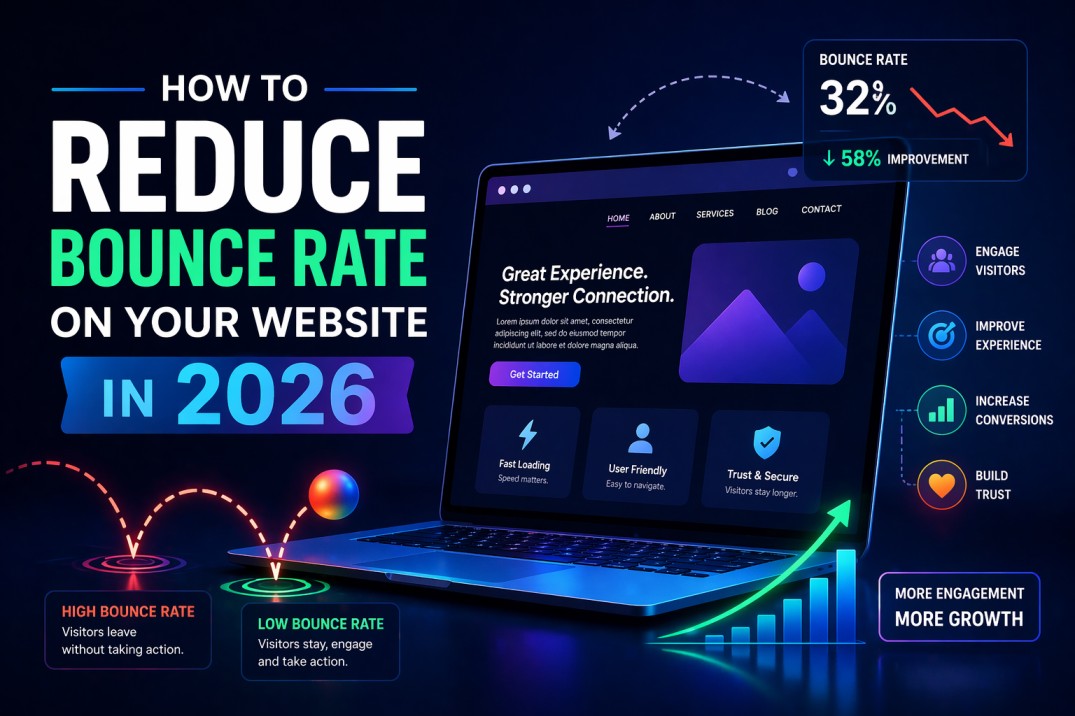
Getting people to visit your website is no longer the hardest part.
Keeping them there is.
In 2026, businesses are generating more traffic than ever through ads, SEO, and social media. But a large percentage of that traffic disappears within seconds. Visitors land on a page, hesitate, and leave without interacting. No clicks, no engagement, no conversion.
That is your bounce rate and it is quietly draining the value of everything you are doing to attract attention online.
The truth is simple: traffic without engagement is wasted opportunity.
Reducing bounce rate is not about tricks or quick fixes. It is about understanding how people behave online and designing an experience that meets their expectations instantly.
When someone lands on your website, they are not reading every word. They are making a rapid judgment.
Within a few seconds, they are subconsciously asking: Is this relevant to me? Can I trust this? What do I do next?
If your website does not answer those questions immediately, they leave.
This is not impatience, it is the reality of modern digital behavior. According to insights from Google, users form opinions about a webpage almost instantly, and those early impressions determine whether they stay or go.
So reducing bounce rate starts with one principle: deliver clarity and value immediately.
Most websites fail in the first few seconds, not because they lack value, but because they fail to communicate it clearly.
A visitor should not have to figure out what your business does. It should be obvious the moment the page loads. Your headline, layout, and visual hierarchy must work together to answer a simple question: Why should I stay here?
If your messaging is vague, cluttered, or slow to load, users will not wait. They will leave and find a clearer alternative.
Speed plays a major role here. A slow-loading page creates friction before the experience even begins. If your site takes too long to load, you lose users before they even see your content. No amount of great design can fix a delay that drives people away at the door.
Another major reason for high bounce rates is misalignment.
A user clicks on your website expecting one thing, and what they see does not match that expectation. This could happen because of misleading headlines, unclear ads, or poorly structured landing pages.
When expectation and reality do not align, trust breaks instantly.
Reducing bounce rate requires consistency across your entire funnel. What you promise before the click must match what you deliver after the click. When users feel that alignment, they stay longer and engage more deeply.
Traditional websites are built to present information, not to interact.
They assume that users will read, understand, and navigate on their own. But that assumption is flawed. Most users have questions, uncertainties, or hesitations, and when those are not addressed immediately, they leave.
This is where modern websites are evolving.
Instead of being passive, they are becoming interactive. They guide users, respond to questions, and help visitors move toward decisions in real time.
Tools like Nexus Botix play a critical role in this shift. By adding an intelligent AI chatbot to your website, you create an environment where users are not left alone to figure things out. They can ask questions instantly, get answers tailored to your business, and move forward without friction.
This transforms the experience from static to dynamic, and dynamic experiences keep people engaged.
Another hidden driver of bounce rate is complexity.
When a page feels overwhelming, users disengage. Long blocks of text, unclear structure, and too many competing elements create cognitive friction. Instead of exploring further, users choose the easier option, they leave.
Clarity solves this.
Your content should be structured in a way that allows users to scan quickly and understand immediately. The goal is not to say everything at once, but to guide users step by step.
When your website feels easy to navigate and understand, users stay longer and engage more naturally.
Many websites lose visitors not because they lack value, but because they lack direction.
A visitor lands on a page and does not know what to do next. There is no clear path forward, no obvious action to take.
When this happens, the user leaves, not because they are not interested, but because they are not guided.
Every page on your website should lead somewhere. Whether it is exploring more content, making an inquiry, or starting a purchase, the next step should always be clear.
When users feel guided, they move forward. When they feel lost, they exit.
A significant portion of web traffic now comes from mobile devices.
If your website is difficult to navigate on a phone, loads poorly, or feels cramped, users will leave almost instantly. Mobile users are even less patient than desktop users, and their expectations for speed and simplicity are higher.
Reducing bounce rate means designing for mobile first, not as an afterthought.
Reducing bounce rate is not a one-time effort. It is an ongoing process.
You need to understand how users interact with your website, where they stay, where they leave, and what they are looking for.
This is where intelligent systems become valuable. Platforms like Nexus Botix do more than engage users; they provide insight into user behavior. By analyzing conversations and interactions, you can identify gaps in your content and continuously refine your experience.
Over time, this creates a feedback loop where your website becomes more effective with each improvement.
The most important shift in 2026 is this: websites are no longer just pages—they are experiences.
Users expect interaction, guidance, and responsiveness. They want to feel understood, not left to navigate alone.
Reducing bounce rate is ultimately about meeting that expectation.
When your website:
Bounce rate naturally decreases.
This is where the game changes.
If users leave because they don’t get answers fast enough, the solution is obvious: give them answers instantly.
An AI chatbot transforms your website from a static page into an interactive experience. Instead of forcing visitors to search for information, it allows them to simply ask.
With Nexus Botix, your website becomes responsive the moment someone arrives.
A visitor no longer has to wonder:
They can just ask, and get immediate, accurate answers.
What makes Nexus Botix powerful is not just speed, but intelligence. You can train it using your website, documents, and business data, so it responds with relevant, context-aware information, not generic replies.
Instead of losing visitors due to uncertainty, you guide them forward through conversation.
This changes everything.
A visitor who might have bounced now:
In simple terms, the chatbot doesn’t just reduce bounce rate it converts hesitation into action.
Bounce rate is not just a number. It is a reflection of how well your website connects with your audience.
If users are leaving quickly, it is not because they are uninterested, it is because something is missing.
The solution is not more traffic. It is better experience.
By combining clarity, speed, structure, and intelligent engagement through tools like Nexus Botix, you can transform your website from a passive destination into an active system that captures attention and drives action.
If you’re ready to turn your website into an engaging, high-converting experience, start using Nexus Botix and interact with your visitors the moment they arrive.