Physical Address
304 North Cardinal St.
Dorchester Center, MA 02124
Physical Address
304 North Cardinal St.
Dorchester Center, MA 02124
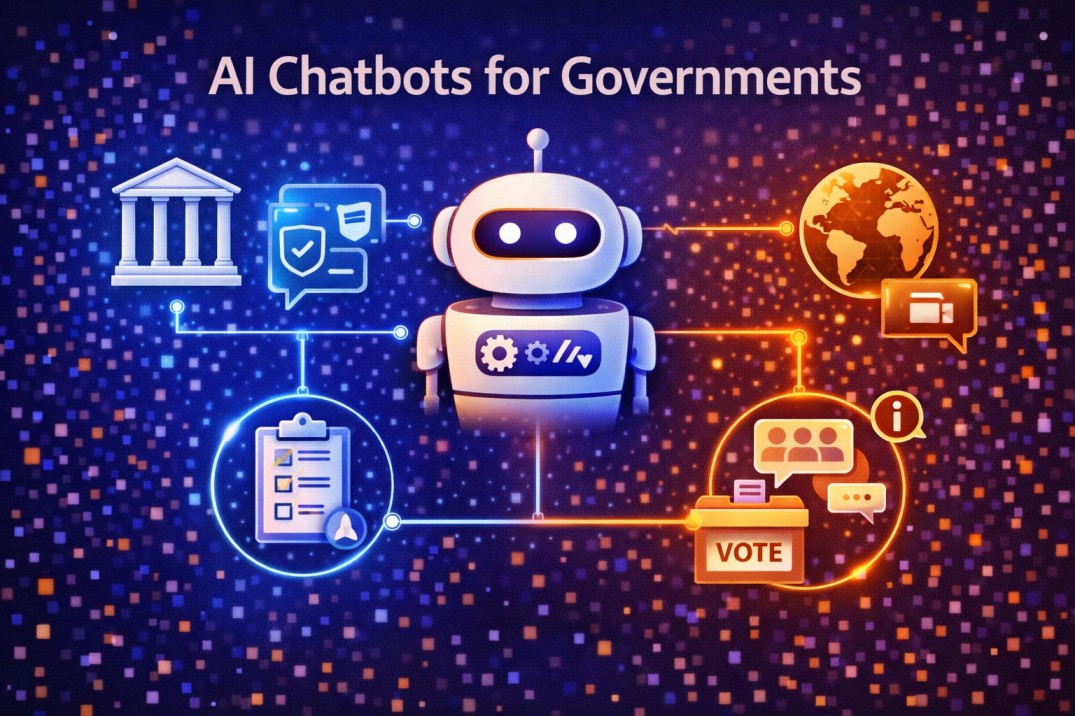
In 2026, public expectations of government services have shifted dramatically. Citizens now expect the same speed, accuracy, personalization, and accessibility from government services that they receive from the best private sector brands. Whether renewing a driver’s license, checking tax deadlines, or accessing social welfare information, citizens want answers now not in hours, days, or even weeks.
Yet traditional bureaucratic systems remain slow, expensive, and fragmented. Governments spend a significant portion of their operational budgets just managing routine inquiries and paperwork, often with limited staff. According to OECD, public sector agencies in many countries spend up to 30% of their budgets on citizen service operations a cost that is unsustainable in a digital age.
Enter AI chatbots. Far from simple scripted assistants of the past, today’s AI chatbots are intelligent, context-aware systems capable of handling complex conversations, guiding citizens through processes, and even generating actionable insights for policymakers. Governments across the world are now leveraging advanced platforms like Nexus Botix to fundamentally transform public service delivery.
The traditional model of citizen service delivery often involves long queues, call centers with limited hours, and manual case processing. This can lead to frustration, delays, and high operational costs.
AI chatbots change this paradigm by:
According to McKinsey & Company, AI and automation technologies could reduce government operational costs by up to 20–40% while simultaneously boosting service quality. This is not hypothetical it is already happening in multiple countries.
Unlike traditional rule-based bots that follow predefined scripts, modern AI chatbots are capable of deep language understanding, context retention, and adaptive responses. Today’s AI chatbots can:
This makes them more than assistants — they become digital public servants.
The government of Singapore introduced an AI chatbot known as Ask Jamie, designed to answer citizen queries across a wide range of public services, including taxes, healthcare, transportation, and public housing.
Ask Jamie integrates information from multiple government agencies and uses natural language understanding to interpret citizen questions. Since its launch, the chatbot has:
According to official reports, Ask Jamie has helped reduce repetitive inquiries, allowing human agents to focus on complex cases that require human judgment.
Estonia, often cited as a global leader in digital governance, integrates AI-driven assistants as part of its e-Government platform. Estonian AI chatbots help citizens with:
The Estonian model emphasizes interoperability — chatbots are connected across departments, allowing citizens to receive continuous services without redundant steps. This has significantly lowered administrative overhead while increasing transparency and satisfaction.
In the UAE, several emirates have launched AI-driven virtual assistants to support public services. One prominent example is “Rashid”, an AI chatbot used to support citizen inquiries in areas such as:
Rashid operates across multiple languages and platforms, including government websites and mobile channels. The UAE’s approach places a heavy emphasis on user experience design, ensuring that interactions are intuitive, helpful, and fast.
Traditional chatbots operate on predefined rules: if a user says X, respond with Y. These systems break down when encountering any input outside the expected patterns.
Modern AI chatbots especially those built on platforms like Nexus Botix use advanced natural language processing models and retrieval-based architecture. Instead of rigid scripts:
This means citizens are treated to conversations that feel natural, relevant, and accurate, regardless of how they phrase their questions.
In multicultural nations with multiple official languages, AI chatbots are powerful tools for inclusive governance. Citizens should not have to struggle with language barriers to receive services.
Modern AI chatbots can be trained to operate in multiple languages such as:
This capability not only improves accessibility but also ensures equitable service delivery regardless of a citizen’s preferred language. Research from UNESCO shows that multilingual digital tools significantly increase access to services and citizen engagement in diverse populations.
AI chatbots reduce government costs in multiple ways:
For example, according to estimates from World Bank, digital automation can cut administrative costs by up to 40% in public-facing workflows when deployed at scale.
One of the unique advantages of AI chatbots is that they generate actionable data. Every interaction provides insight into:
By analyzing this data, governments can:
This data-driven approach enables citizen-centric policy design, rather than reactive governance.
Government AI chatbots operate with sensitive citizen data, and trust is paramount. To maintain confidence, systems must adhere to strict standards:
Transparency also plays a key role: citizens should know when they are interacting with AI, how their data is used, and how to request human intervention if needed.
Platforms like Nexus Botix are designed with these considerations in mind, providing enterprise-grade security and compliance frameworks suitable for public sector deployment.
Deploying an AI chatbot at scale involves a strategic approach:
Phase 1: Discovery & Knowledge Mapping
Identify high-traffic citizen service areas and consolidate relevant documentation (policies, FAQs, guides).
Phase 2: Training the AI
Upload documents, connect knowledge sources, and define persona and tone that aligns with government communication standards.
Phase 3: Controlled Pilot
Deploy the chatbot to a limited audience (e.g., website or WhatsApp channel) and gather interaction data.
Phase 4: Optimization
Refine responses, improve knowledge coverage, and integrate escalation paths for human support.
Phase 5: Full Deployment and Monitoring
Extend to multiple channels and continuously monitor performance metrics such as response accuracy, engagement rates, and citizen satisfaction.
Governments should measure:
Continuous monitoring ensures the system remains relevant, accurate, and aligned with citizen needs.
AI chatbots are not a future trend, they are a public sector imperative. When implemented thoughtfully, they:
Governments that adopt AI agents like those powered by Nexus Botix position themselves not just as service providers, but as responsive, efficient, and citizen-centric institutions prepared for the digital demands of 2026 and beyond.