Physical Address
304 North Cardinal St.
Dorchester Center, MA 02124
Physical Address
304 North Cardinal St.
Dorchester Center, MA 02124
In 2026, chatbots are no longer experimental tools, they are core revenue and customer experience infrastructure. Businesses are not just using AI to respond faster; they are using it to capture leads, improve customer satisfaction, and drive measurable ROI.
Yet, there is a clear divide. Some chatbots feel intelligent, helpful, and conversion-driven. Others feel robotic, disconnected, and ultimately ignored.
The difference lies in strategy.
Research from Gartner and McKinsey & Company consistently shows that AI delivers the most value when it is aligned with customer journeys and business outcomes, not just deployed as a standalone tool. This is where platforms like Nexus Botix become powerful, not simply because they enable automation, but because they allow businesses to design intelligent, outcome-driven conversations.
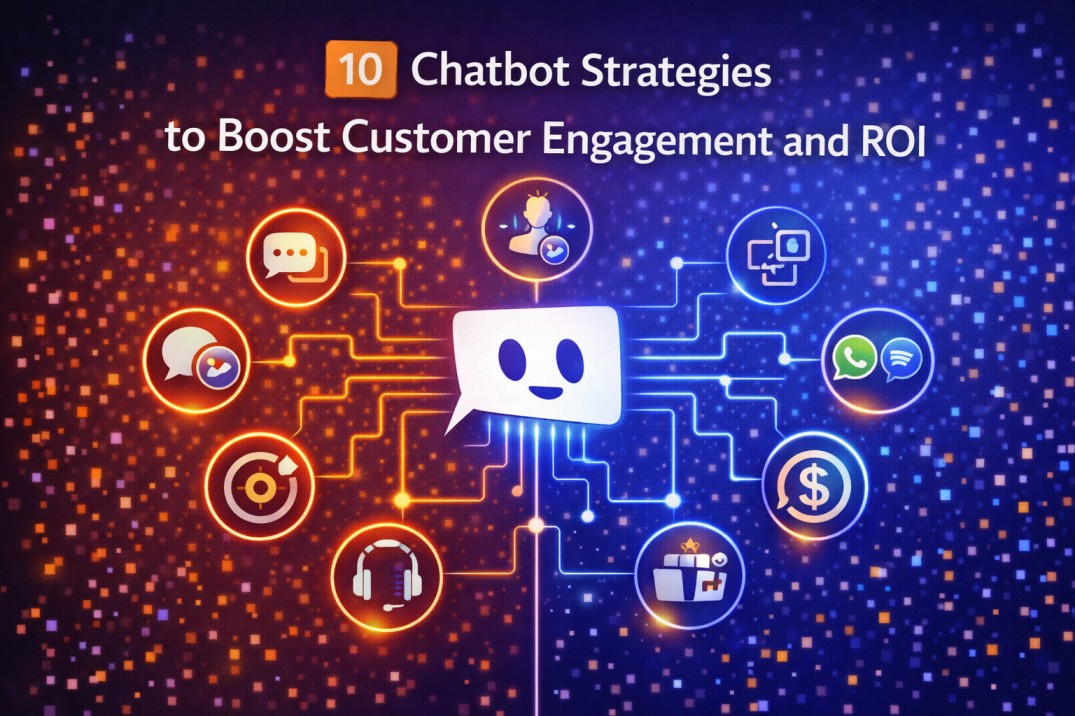
What follows is not a list of tips, but a strategic framework, ten interconnected approaches that define high-performing chatbot systems in 2026.
A chatbot should never be deployed without a clear purpose. The most effective systems are built around specific, measurable goals such as lead generation, customer support efficiency, or conversion optimization.
If your objective is lead generation, your chatbot must be designed to guide users toward providing contact information. If your focus is customer satisfaction, then response accuracy and resolution speed become the priority.
Insights from Harvard Business Review emphasize that AI systems generate ROI only when directly tied to business outcomes. Within Nexus Botix, this means configuring your AI not just to answer questions, but to move users toward defined outcomes.
Customer engagement begins with understanding why users initiate conversations.
Studies from IBM highlight that intent recognition is central to effective AI systems. Users do not think in terms of features, they think in terms of problems.
A well-designed chatbot anticipates these problems and structures responses accordingly. Whether a user is exploring pricing, seeking support, or evaluating a service, the chatbot should immediately align with that intent.
This approach transforms interactions from generic exchanges into goal-oriented conversations.
Customer satisfaction is directly tied to response quality. A chatbot that provides unclear or incorrect answers quickly erodes trust.
Research from Deloitte confirms that data quality is a primary determinant of AI performance. High-performing chatbots rely on structured, relevant, and continuously updated knowledge sources.
Within Nexus Botix, this means curating your training data carefully, prioritizing clarity over volume. Accurate responses not only improve satisfaction but also increase the likelihood of conversion.
One of the most underutilized capabilities of chatbots is their ability to act as lead generation engines.
Instead of passively answering questions, a well-optimized chatbot actively guides users toward meaningful actions. This could involve capturing emails, qualifying prospects, or recommending next steps.
According to Salesforce, customers are more likely to engage when interactions feel personalized and purposeful. By integrating lead capture into natural conversation flows, businesses can convert engagement into pipeline growth.
Customer satisfaction is not just about solving problems, it is about how quickly and effectively those problems are resolved.
AI chatbots excel in delivering instant responses, but speed alone is not enough. Responses must also be relevant and context-aware.
Insights from Forrester show that customer experience is significantly improved when interactions are both fast and accurate. This is where AI systems trained on structured knowledge outperform traditional automation.
By leveraging Nexus Botix, businesses can deliver responses that are not only immediate but also aligned with user intent, leading to higher satisfaction rates.
Even the most advanced chatbot cannot handle every scenario. Complex or sensitive issues require human intervention.
The key is designing a system where AI and humans work together seamlessly. According to PwC, customers expect a balance between automation and human support.
Effective chatbots include intelligent escalation mechanisms, ensuring that users are transferred to human agents at the right moment. This prevents frustration and maintains trust.
Engagement is heavily influenced by accessibility.
Deploying your chatbot on platforms like WhatsApp and Facebook Messenger ensures that interactions occur in environments where users are already active.
With Nexus Botix, businesses can integrate across these channels, creating a unified communication layer that supports both engagement and lead generation.
Personalization is a key driver of both engagement and ROI.
Research from Accenture indicates that personalized experiences significantly increase customer satisfaction and conversion rates. Chatbots that adapt responses based on user intent, behavior, or context create more meaningful interactions.
This level of personalization transforms chatbots from simple tools into intelligent assistants that guide decision-making.
A chatbot that is not measured cannot be improved.
To understand its impact, businesses must track key performance indicators such as:
Organizations like Google emphasize the importance of data-driven evaluation in AI systems. Monitoring these metrics provides insight into what is working and what needs refinement.
The most important strategy is also the most overlooked, continuous improvement.
AI systems are not static. They evolve based on new data, changing customer behavior, and business needs.
Every interaction is an opportunity to improve. By analyzing conversation logs, identifying gaps, and refining knowledge sources, businesses can continuously enhance performance.
With Nexus Botix, this process becomes a structured loop:
monitor → measure → optimize → scale.
Over time, this iterative approach leads to:
To fully understand how these strategies connect, consider the following:
| Strategic Area | Business Impact |
|---|---|
| Intent-driven design | Higher engagement |
| Knowledge quality | Improved accuracy and trust |
| Lead generation focus | Increased revenue pipeline |
| Personalization | Higher conversion rates |
| Monitoring & optimization | Continuous ROI growth |
In 2026, chatbot success is no longer defined by whether you have one, it is defined by how intelligently it is implemented.
Businesses that treat chatbots as strategic assets, aligned with lead generation, customer satisfaction, and continuous improvement—are the ones seeing real results.
Platforms like Nexus Botix provide the infrastructure, but it is the application of these strategies that transforms automation into a measurable growth engine.
If you want to build a chatbot that drives engagement, captures leads, and continuously improves over time, start implementing these strategies with Nexus Botix today.