Physical Address
304 North Cardinal St.
Dorchester Center, MA 02124
Physical Address
304 North Cardinal St.
Dorchester Center, MA 02124
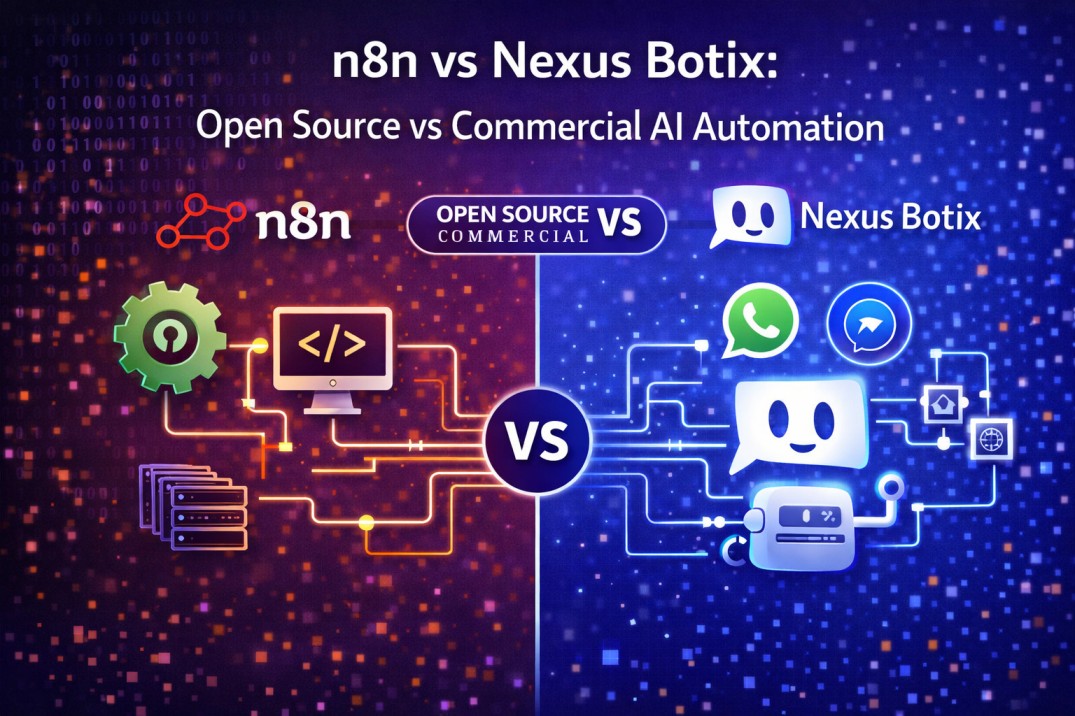
As AI automation becomes a core part of modern business infrastructure, teams are increasingly faced with a critical architectural decision: should you build with open-source tools or adopt a commercial AI platform?
This is not just a tooling choice it is a decision about speed, scalability, control, and long-term operational efficiency.
On one side, you have n8n, a powerful open-source workflow automation engine designed for developers who want full control over integrations and backend logic. On the other side, you have Nexus Botix, a commercial AI automation platform built to transform business knowledge into intelligent, customer-facing AI agents.
Understanding the difference between these two approaches requires looking beyond features and into how each system is designed, what problems they solve, and how they scale in real-world environments.
At its core, n8n is built around process automation. It enables developers to design workflows where triggers, conditions, and actions are connected in a structured pipeline. If something happens in one system, n8n can trigger a chain of events across multiple services.
This makes it extremely powerful for backend automation, such as syncing databases, sending notifications, or orchestrating APIs.
In contrast, Nexus Botix is built around intelligence-driven automation. Instead of focusing on workflows, it focuses on understanding and responding to human input.
It allows businesses to train AI agents using documents, links, and internal knowledge so that the system can interpret customer questions and generate accurate responses in real time.
This fundamental difference defines everything else.
n8n executes logic. Nexus Botix interprets intent.
The architecture of n8n is event-driven and deterministic. Every automation must be explicitly defined. You create nodes, connect them, define triggers, and specify outputs. If a condition is not programmed, it does not exist.
To add AI capabilities within n8n, developers typically integrate external services such as OpenAI or Anthropic, then build custom logic around them. This adds flexibility, but also increases complexity.
By contrast, Nexus Botix uses a retrieval-based AI architecture. Business knowledge is indexed and structured so that when a user asks a question, the system retrieves relevant information and generates a response grounded in that data.
There is no need to define every possible conversation path. The system adapts dynamically based on the query.
This makes Nexus Botix inherently better suited for:
One of the biggest trade-offs between open-source and commercial platforms is the balance between control and usability.
With n8n, developers have full control over infrastructure, workflows, and integrations. It can be self-hosted, customized extensively, and adapted to highly specific use cases.
However, this level of control comes with responsibility. Teams must manage hosting, monitor performance, handle errors, and maintain integrations over time.
In contrast, Nexus Botix abstracts away this complexity. The platform is designed so that businesses can deploy AI agents without writing code or managing infrastructure.
Instead of building workflows, users focus on training the AI with business knowledge and deploying it across communication channels.
This makes Nexus Botix significantly more accessible to non-technical teams such as customer support, marketing, and operations.
Speed is often the most underestimated factor in automation decisions.
With n8n, deployment involves multiple steps: setting up hosting, configuring workflows, integrating APIs, and testing logic. For experienced developers, this is manageable, but it still requires time.
With Nexus Botix, deployment is almost immediate. Businesses can upload documents, connect a knowledge source, and deploy an AI agent within a short time frame.
The platform also integrates directly with messaging channels such as WhatsApp and Facebook Messenger, allowing companies to start automating customer conversations without building additional systems.
This difference in time-to-value is critical, especially for startups and fast-moving teams.
Open-source tools like n8n are often perceived as free, but this can be misleading.
While there is no licensing fee, businesses still incur costs related to:
For technical teams, this may be acceptable. For non-technical organizations, it can become a bottleneck.
Commercial platforms such as Nexus Botix offer predictable subscription pricing. This includes hosting, AI model access, infrastructure, and support.
The trade-off is clear: n8n minimizes software cost but increases operational complexity, while Nexus Botix simplifies operations but introduces a fixed monthly cost.
| Capability | n8n | Nexus Botix |
|---|---|---|
| Core Focus | Workflow automation | AI-powered communication |
| Hosting | Self-hosted or cloud | Fully managed |
| AI Capabilities | Requires integration | Built-in AI agents |
| Knowledge Training | Not native | Core feature |
| Customer Support Automation | Custom build required | Native capability |
| Messaging Integrations | API-based setup | Direct (WhatsApp, Messenger) |
| Ease of Use | Developer-focused | Business-friendly |
| Time to Deploy | Moderate to high | Very fast |
This comparison highlights a key insight: these tools are not direct substitutes. They operate at different layers of the automation stack.
Choosing n8n makes sense when your primary goal is to build custom backend workflows and you have the technical expertise to support it.
It is particularly valuable for:
In these cases, flexibility outweighs convenience.
Choosing Nexus Botix makes sense when your goal is to deploy intelligent AI agents quickly and efficiently.
It is especially effective for:
Instead of building systems from scratch, businesses can focus on results and outcomes.
In many real-world scenarios, the most effective strategy is not choosing one over the other, but combining both.
For example, n8n can handle backend workflows such as CRM updates, data synchronization, and notifications, while Nexus Botix manages customer-facing conversations.
This creates a layered automation architecture where:
This approach allows businesses to maximize both flexibility and efficiency.
The debate between open-source and commercial automation is not about which is better, it is about which aligns with your business objectives.
If your priority is deep customization and infrastructure control, n8n is a powerful choice.
If your priority is speed, scalability, and intelligent customer interaction, Nexus Botix offers a purpose-built solution designed for modern business needs.
Understanding this distinction allows you to make smarter architectural decisions and build automation systems that scale with your business.
Want to deploy AI agents without spending months building workflows?
Start using Nexus Botix today and turn your business knowledge into intelligent, customer-facing automation.